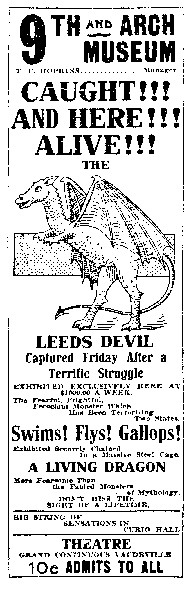
In 18th and 19th centuries the Jersey Devil was spotted sporadically throughout the Pine Barrens region, frightening local residents and any of those brave enough to traverse the vast undeveloped expanses of New Jersey’s southern reaches. Unearthly wails were often reported emanating from the dark forests and swampy bogs, and the slaughter of domesticated animals would invariably be attributed to the Phantom of the Pines. Over the years the legend of the Leeds Devil grew, occasionally even overstepping the boundaries of its rural Pine Barrens haunt to terrorize local towns and cities.

The most infamous of these incidents occurred during the week of January 16 through 23, 1909. Early in the week reports starting emerging from all across the Delaware Valley that strange tracks were being found in the snow. The mysterious footprints went over and under fences, through fields and backyards, and across the rooftops of houses. They were even reported in the large cities of Camden and Philadelphia. Panic immediately began to spread, and posses formed in more than one town. Fear and intrigue grew even greater when it was reported that bloodhounds refused to follow the unidentified creature’s trail in Hammonton. Schools closed or suffered low attendance throughout lower NJ and in Philadelphia. Mills in the Pine Barrens were forced to close when workers refused to leave their homes and travel through the woods to get to their jobs.
Eyewitnesses spotted the beast in Camden and in Bristol, Pennsylvania, and in both cities police fired on it but did not manage to bring it down. A few days later it reappeared in Camden, attacking a late night meeting of a social club and then flying away. Earlier that day it had appeared in Haddon Heights, terrorizing a trolley car full of passengers before flying away. Witnesses claimed that it looked like a large flying kangaroo. Another trolley car-full of people saw it in Burlington when it scurried across the tracks in front of their car. In West Collingswood it appeared on the roof of a house and was described as an ostrich-like creature. Firemen turned their hose upon it, but it attacked them and then flew away. The entire week people reported that their livestock, particularly their chickens, were being slaughtered. This was most widespread in the towns of Bridgeton and Millville.
The marauding misanthrope reappeared later in the week in Camden, where a local woman found the beast attempting to eat her dog. She hit it with a broomstick and it flew away.
There are still many, however, who believe that the Jersey Devil is a very real, very dangerous creature. There has been a constant stream of reports over the years of Devil encounters. Most often, people report finding strange, unidentifiable tracks in the sandy soil in desolate areas of the Pine Barrens. Some reports claim that they are the footprints of a strange bird. Others say that they closely resemble hoofprints, although whatever it is walks on just two legs. There have even been a substantial amount of reports that describe the tracks as being cloven, a well-cited description of the feet/hooves of a more famous Devil–Satan. While less frequent, there are still occasional reports of people who see more than just tracks and manage to catch a glimpse of ol’ JD himself. He is most commonly described as having the body of a kangaroo, the head of a dog, the face of a horse, large leathery wings, antlers similar to those of a deer, a forked reptilian tail and intimidating claws.
While some Jerseyans embrace their Devil as nothing more than a quaint figment of our collective imagination, a source of unification and pride, and a unique and important piece of NJ folk culture, others see it as a very real creature and a threat to their safety. Still others who have sworn they did not believe in the existence of the Jersey Devil have had their minds changed after spending just one moonlit night in the Pine Barrens. There, where a ghostly mist drifts across the cedar swamps and the unearthly cry of some unseen creature can be heard piercing the stillness of the dark forest, few disbelievers can be found. Whether its deep in the Pine Barrens or deep in our collective unconscious, one thing is certain–the Devil still lurks in New Jersey, and most likely always will.